
China's policy towards Pakistan is driven primarily by its interest in countering India in the region and diverting its military and strategic attention away from Beijing, an influential South Asian expert has said. "Chinese officials view certain degree of Indo-Pakistan tension as advancing their own strategic interests, as such friction bogs India down in South Asia and interferes with New Delhi's ability to assert its global ambitions," said Lisa Curtis.

The Asian Development Bank (ADB) on Wednesday slashed India's GDP growth forecast for FY23 to 7 per cent from the earlier estimate of 7.2 per cent mainly on account of higher inflation and a tight monetary policy. India's economy grew 13.5 per cent year-on-year in the first quarter of 2022-23, reflecting strong growth in services, ADB said in its second supplement to Asian Development Outlook Report 2022 (ADO 2022). "However, GDP growth is revised down from ADO 2022's forecasts to 7 per cent for FY2022 (ending March 2023) and 7.2 per cent for FY2023 (ending March 2024) as price pressures are expected to adversely impact domestic consumption, and sluggish global demand and elevated oil prices will likely be a drag on net exports," ADB said.
Amid concerns over its attempts to increase its influence in South Asia, China has described India as its "partner and not rival" and expressed willingness to work with New Delhi and other South Asian Association For Regional Cooperation members to improve regional connectivity.

VFS Global expects visa applications from India to surpass pre-pandemic levels in 2024 with the easing of appointment availability. Vishal Jairath, head-South Asia, VFS Global, said during a media interaction that based on indications from the client governments in terms of appointment availability and the resources deployed by them, visa applications would surpass the pre-Covid levels by a healthy margin. "We have geared up. We have looked at our infrastructure and increased capacity in many locations," he added.
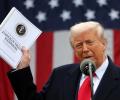
"These latest so-called 'Liberation Day' tariffs are reckless and self-destructive, inflicting financial pain on Illinois at a time when people are already struggling to keep their small businesses afloat and put food on the table."

In anticipation of a verdict to be delivered by the International Tribunal of the Permanent Court of Arbitration in The Hague on Tuesday, China has orchestrated a worldwide campaign to defuse its findings.
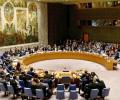
The United Nations Security Council held closed-door consultations on rising tensions between India and Pakistan, with envoys calling for restraint and dialogue. The consultations, requested by Pakistan, lasted for about an hour and a half. UN Secretary-General Antonio Guterres expressed concern over the tensions, urging both countries to avoid a military confrontation. India's former Permanent Representative to the UN, Syed Akbaruddin, said that no consequential outcome could be expected from the discussion.

It was clear in Brunei at the 8th East Asia Summit that China doesn't want the South China Sea issue to even dominate the discussion, reports Sheela Bhatt, who is part of the prime minister's media contingent to the summit

China is building the world's highest-altitude cloud computing data centre in Tibet that will meet the data storage needs of the country and South Asian nations like Nepal, Bangladesh and Pakistan, official media reported on Thursday.

The National Security Strategy document should flag all major issues concerning security strategy and provide guidelines to concerned departments to work out suitable action plans. Since the global and regional geopolitical canvas is dynamic, the NSS document should be deliberated at length before formulation and should be reviewed periodically, recommends Commodore Venugopal Menon (retd).

'India's specific concerns about whether Russia will be a reliable defense supplier and diplomatic partner in the event of heightened hostilities with China has undoubtedly accelerated the process of US-India defense and intelligence cooperation intended to support Indian military positions along the Line of Actual Control.'

The virtual talks took place under the framework of Working Mechanism for Consultation and Coordination on India-China Border Affairs.
'Border disputes cannot be solved by resorting to border conflicts. Only by mutual consensus, and a spirit of give-and-take, can we arrive at a long-lasting solution,' says Professor Wang Dehua, ahead of Prime Minister Manmohan Singh's visit to China next week.' Exclusive to Rediff.com
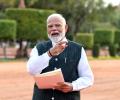
Pakistani-American businessman Sajid Tarar said like India, Pakistan also needs strong leadership to handle political instability and economic issues.
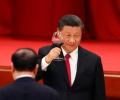
He claimed China has a policy of keeping "hot spots like Taiwan, South China Sea and Tawang burning" in order to divert attention to its own failings.

We can expect to see more Chinese wolf warrior diplomats on the prowl, in India's neighbourhood, though its mailed fist is not so visible while dealing with India, observes Colonel R Hariharan (retd).

The first summit in South Asia, it will host the largest delegation of 43 heads of State and government as well as the heads of international organisations.

'Geopolitics will be the most important driver of financial markets in 2025.'
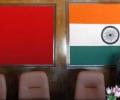
India on Friday strongly protested China's decision to issue invalid visas to some of its athletes for the Asian Games.
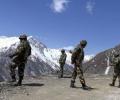
...with extravagant claims in both the eastern and western sectors, observes Ambassador Talmiz Ahmad, as India is fixated on asserting its border claims based on the McMahon Line.
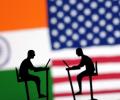
India and the visiting US officials have decided to hold a wrap-up session on Saturday morning to conclude the three-day talks on the proposed bilateral trade agreement, government sources said. They said the discussions are at a "very" early stage.

China plans to divert about 200 billion cubic metres of water annually from the Brahmaputra at its highest point, namely the Great Bend, where it turns into India. China's Brahmaputra dam will severely impact India, warns former senior RA&W officer and China expert Jayadeva Ranade.

Most economists expect the global economy to weaken in the coming year amid political and financial volatility, but a large majority of over 90 per cent are confident of moderate or strong growth in South Asia, notably India, a survey showed on Friday. At the same time, the outlook for China has dimmed following signs of deflationary pressures and fragility in the country's real estate market, the World Economic Forum's latest 'Chief Economists Outlook' report said. As the world grapples with political and financial volatility, almost six in 10 believe the global economic outlook will undermine progress towards meeting the UN Sustainable Development Goals (SDGs), with 74 per cent saying geopolitical tensions will have the same effect.

The balloon, which was being used by the People's Republic of China in an attempt to surveil strategic sites in the continental United States, was brought down above US territorial waters.

India's stock markets are experiencing a shift in investor sentiment, with a 30 per cent surge in Chinese stocks, prompting investors to move money from domestic markets to China. This reversal of fortunes is a notable change from the past three years, where China's losses benefited India.

The developments in Af-Pak region, particularly the fall out of Pak political paralysis, would make President Xi Jinping's task a little more complicated, says Colonel R Hariharan.
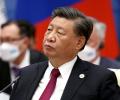
Xi Jinping's recent actions in South Asia have amply demonstrated the disastrous impact of China's embrace, observes Jayadeva Ranade, the retired senior RA&W officer and China expert.
Notwithstanding the growing political ties, China has accused India, its biggest trade partner in South Asia, of carrying out restrictive trade practices, including technical barriers, opaque and complicated regulations
The Indian economy, severely hit by the coronavirus pandemic, is projected to contract by a massive 10.3 per cent this year, the International Monetary Fund said on Tuesday. However, India is likely to bounce back with an impressive 8.8 per cent growth rate in 2021, thus regaining the position of the fastest growing emerging economy, surpassing China's projected growth rate of 8.2 per cent, the IMF said in its latest 'World Economic Outlook' report.
Describing India and Pakistan as its important neighbours, China on Thursday said the two countries should engage in "friendly consultations" to resolve the Kashmir issue and strengthen their cooperation for peace and stability in South Asia.
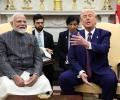
'Trump administration wanted a positive tone at this summit, but there was still some anxiety that there could be some awkward moments -- and there were not.'

FMCG major HUL on Friday announced the appointment of Rohit Jawa as the managing director & chief executive officer to succeed Sanjiv Mehta who will retire from the company after leading it for a decade. Jawa, presently the Chief of Transformation for Unilever, would take over the leadership role for a term of five consecutive years with effect from June 27, 2023, the company said in a statement. "The appointment of Rohit Jawa as a whole-time director and MD & CEO will be subject to approval of Shareholders and other statutory approvals as may be applicable," it added.
The deepening of strategic relationship between India and the US has unnerved China, an eminent American scholar said, arguing that Beijing's four-decade-old policy of dealing with New Delhi on their own terms has gone haywire.

Brazil shocked and other big upsets at World Cup qualifiers played on Tuesday
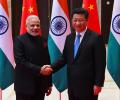
'We hope that both India and Pakistan can exercise restraint and do more to improve their bilateral relations'
Terming Sino-India ties as one of the most important bilateral relationships for China, the People's Liberation Army on Tuesday said that it wants to build "new type" of military relations with Indian defence forces to promote peace and stability at the borders and in South Asia.
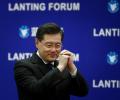
Qin, who is visiting New Delhi to attend the G20 Foreign Ministers meeting on Thursday, is expected to meet Jaishankar on its sidelines though the foreign ministry here is tight-lipped about it.

"Instead of talking about war, we must increase trade many fold, we should have common goals for space, energy and food security. India and China should protect the supply chain. Like securing Malacca Straits from pirates on the high seas. Both countries should jointly find ways to use high technology for poverty reduction. And evolve a consensus on environment and terrorism-related issues."
China assured the Pakistani president of maintaining their 'all weather' relationship.
